The NYC Mattress Guide
Choosing an Organic Sleep Surface for a Small City Apartment
An organic mattress can be a thoughtful choice for an urban home, but the label is only the beginning. Materials, firmness, dimensions, certifications, delivery logistics, and everyday care all matter—especially when your bedroom is compact and the route to it passes through a narrow hallway, a shared elevator, or an old walk-up.
A practical guide to choosing a mattress that fits your body, your room, and the realities of city living.
Start with the room, not the product page
In a small apartment, a mattress is both a sleep surface and a significant piece of furniture. Before comparing materials or browsing finishes, take stock of the room it needs to occupy. Measure the available floor area, note the position of doors and windows, and consider how much clearance you need to walk around the bed, open drawers, and reach closets. A mattress that technically fits can still make a bedroom feel difficult to use if it leaves no room for circulation.
Standard mattress dimensions are useful reference points, but the frame, headboard, and bedding can add to the footprint. A queen mattress measures 60 by 80 inches; a full is generally 54 by 75 inches; and a twin is typically 39 by 75 inches. A Twin XL is longer—39 by 80 inches—and may suit a taller sleeper when the room is narrow. Check the exact dimensions listed by the maker, since product specifications and available sizes can vary.
Think beyond the sleeping area. Will a bedside table still fit? Can the bedroom door open fully? Is there enough space to change sheets without pushing furniture into a wall? If you share the bed, consider whether moving down a size would compromise comfort, or whether a more efficient frame could preserve the room’s usable space. The right choice is a balance: enough width and length for restful sleep, without allowing the bed to dominate every other function of the room.
It is also worth measuring the mattress frame itself. Platform beds, storage frames, and headboards may extend beyond the mattress edges. If your current frame is staying, verify that it is compatible with the mattress type and that its support system meets the manufacturer’s requirements. A well-chosen organic mattress still needs an appropriate, stable foundation.
Map the delivery route before you order
In a city apartment, getting the mattress into the bedroom can be as consequential as choosing it. A product’s listed dimensions describe its final size, not necessarily how it moves through your building. Measure the narrowest points along the route: the apartment entry, interior doorways, hall turns, stair landings, and elevator opening and interior. Include the height of low ceilings and the clearance around handrails or light fixtures where relevant.
Ask the retailer how the mattress is packaged and whether it can be bent or compressed during delivery. Some mattresses ship in a compact box; others arrive at full size. Do not assume that a boxed mattress will be effortless to maneuver: the package can be heavy, and the box may be long enough to create problems around tight corners. Conversely, a flexible mattress should not be folded or bent beyond the handling instructions provided by its maker.
Confirm whether delivery is to the building entrance, the apartment door, or the room of your choice. Ask whether the service includes setup, removal of packaging, or disposal of an old mattress, and whether these options carry additional charges. In New York City, building policies may affect delivery hours, elevator reservations, service entrances, and the use of protective coverings in common areas. A quick conversation with building management or a superintendent can prevent a missed delivery or a last-minute change of plan.
If the apartment is in a walk-up, be candid about the number of flights and the tightness of the stairwell when arranging service. Clarify what happens if delivery personnel cannot safely complete the route. Scheduling windows, access instructions, and a reliable contact number are small details that can make the experience considerably smoother.
- Measure every doorway, stairwell, landing, and elevator involved in the delivery route.
- Check the mattress’s shipping dimensions as well as its final size.
- Confirm the delivery scope, setup options, fees, and old-mattress removal terms in writing.
- Ask the building about elevator reservations, delivery hours, and any service entrance rules.
Understand what “organic” does—and does not—tell you
Organic is a useful starting point, not a complete description of comfort, construction, or environmental impact. A mattress may contain several materials, each serving a different purpose: a supportive core, pressure-relieving comfort layers, a fabric cover, and a quilted surface. Read the construction details rather than relying on a prominent front-label claim. Look for clear descriptions of the fill and cover, the origin or processing information provided, and the certifications that apply to each component.
Certifications can help shoppers verify specific claims, but they are not interchangeable. GOTS—the Global Organic Textile Standard—addresses organic fibers and processing requirements for textiles within its scope. GOLS, the Global Organic Latex Standard, applies to organic latex and its supply chain. A certification can apply to a particular component or to a finished product, so check the certificate’s scope and the manufacturer’s documentation rather than assuming every material in a mattress is covered by one mark.
Terms such as “natural,” “eco-friendly,” and “non-toxic” can be broad and are not, on their own, a precise account of what is inside a mattress. Ask for specifics. Is the latex certified organic? What is the cover made from? What materials are used in the quilted layer? Which parts are certified, and by whom? Thoughtful answers should be concrete and understandable, not dependent on vague promises.
Certification also does not predict whether a mattress will suit your body. A certified organic mattress can be too firm, too soft, too warm, or too tall for a particular sleeper or room. The aim is to assess both: the credibility of the materials information and the practical fit of the mattress for your needs.
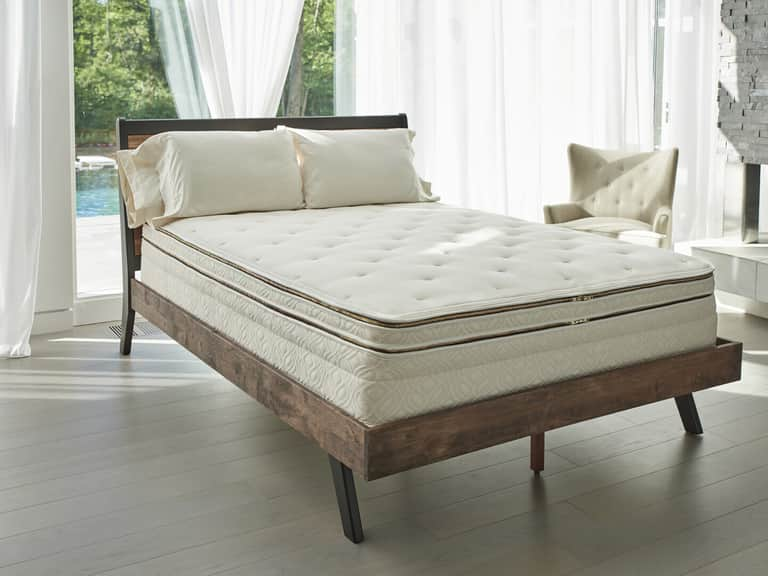
For a closer look at a latex construction, the Naturally Organic Hudson Latex Mattress is described as an eight-inch mattress with a firm five-inch GOLS-certified organic Dunlop latex support layer and a three-inch medium latex comfort layer. Its product information also specifies GOTS-certified organic cotton and wool in the cover and quilting. Those details offer a useful illustration of how to read a materials breakdown: identify the layers, their roles, and the certification named for each material, then compare those facts with your own preferences.
Compare construction, feel, and support
Mattress type is not a shorthand for comfort. Two latex mattresses can feel quite different depending on the thickness and firmness of their layers, the cover, and the way the components are assembled. Before choosing, consider your usual sleeping position, how much cushioning you prefer at the shoulders and hips, whether you share the bed, and whether you tend to sleep warm.
Latex is often valued for a responsive, buoyant feel: it tends to contour without the slow, enveloping sensation many people associate with memory foam. The exact feel depends on the latex’s firmness and construction. A mattress with a firm core and a softer upper layer may offer a different balance of support and pressure relief from a single-firmness design. If possible, try the mattress in person for long enough to notice whether it supports you comfortably in your usual position. If an in-person trial is not practical, read the trial and return terms before buying.
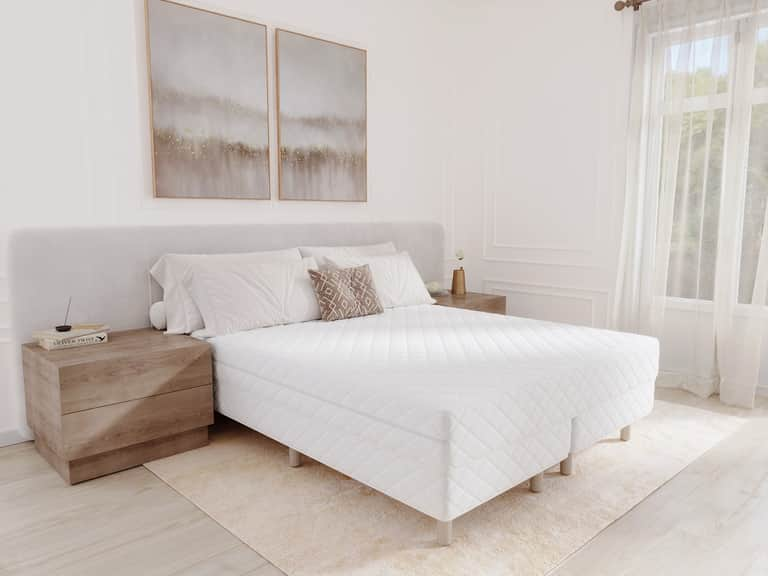
Hybrids combine materials, commonly pairing a coil system with latex or another comfort layer. Their feel depends on the design, and a taller profile may affect both the proportions of a small room and the ease of getting into bed. A 13-inch mattress, for instance, can raise the sleeping surface considerably once a frame is added. That may be desirable for some people, but it can create a towering appearance or make fitted-sheet selection more particular in a compact bedroom.
Firmness labels are not universal measurements. “Medium” on one product may not feel like “medium” on another, and body weight, shape, and sleeping position influence how a mattress feels. Look for the materials and layer descriptions behind the label. If two people share a bed and have different comfort preferences, ask whether split firmness is available in the size you need, and whether it changes the price, lead time, or delivery arrangement.
A compact room can make every furniture decision more visible, but visual neatness should not override support. Choose a mattress that helps you maintain a comfortable sleeping posture rather than selecting by height, label, or style alone. If pain or persistent sleep problems are part of the decision, a mattress is not a substitute for appropriate medical advice.
Height, weight, and small-room proportions
Mattress thickness has a practical dimension as well as an aesthetic one. Add the mattress profile to the height of the foundation and frame, then consider how high the finished bed will sit. A tall bed may make a small room feel visually crowded and can be awkward to get into, while a very low setup may not suit every sleeper. There is no universally correct height; the useful question is whether the completed bed works with your body, furniture, and room.
Weight matters during delivery, setup, and future care. A substantial mattress can be difficult to rotate or move through an apartment, particularly if it has a dense latex core or several layers. Check the manufacturer’s stated weight, if available, and ask whether two-person handling is recommended. Plan for the weight before a delivery team arrives, especially if a narrow route or stairs are involved.
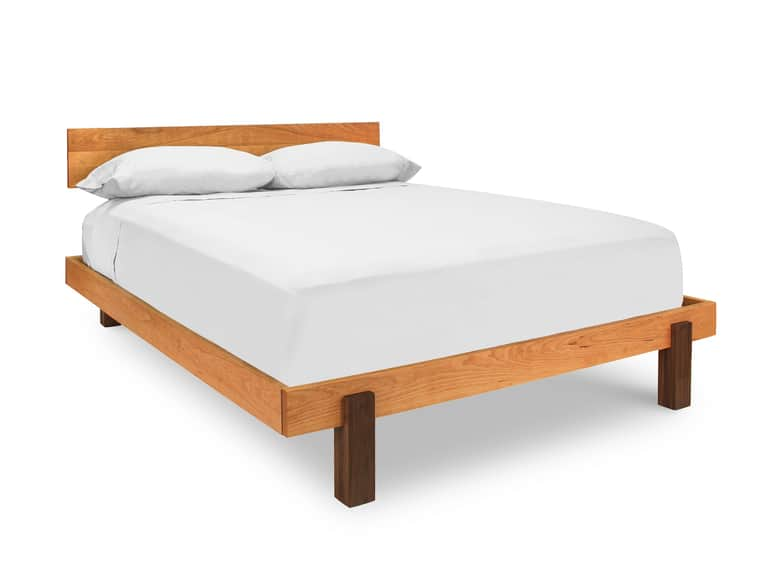
Measure the bed in relation to other pieces of furniture. In a studio or a one-bedroom apartment, the bed may be visible from the living area. A simple profile and a frame with a restrained footprint can help the room feel composed. A platform bed such as the Modern American Platform Bed is made from solid hardwoods and has a platform construction; if considering any frame, verify its size and mattress-support requirements against the mattress specifications. The key is not to match every piece, but to make sure the overall footprint and height suit the space.
Care requirements are part of the purchase
In a small apartment, a mattress is not always easy to move outdoors or turn in a wide, open room. Understand its care instructions before committing. Some mattresses are spot-clean only, and their covers are not designed to be removed or machine-washed. Other products may have specific cleaning precautions. Follow the manufacturer’s directions; improvised cleaning can damage materials or affect a warranty.
A washable mattress pad or protector can help shield the surface from everyday spills, perspiration, and wear, but it should be compatible with the mattress and suited to the protection you need. A breathable cotton pad may add a light layer of comfort and provide a washable barrier, while a waterproof protector is intended to resist liquid. These are different functions. Check fit, pocket depth, laundering instructions, and whether the fabric or backing changes the feel of the mattress.
For an organic sleep setup, read the bedding’s own material and certification information rather than assuming that a mattress’s credentials extend to the protector, sheets, or pillow. A GOTS-certified organic cotton mattress pad, for example, is a separate product with its own construction and care guidance. Select layers that work together without adding so much bulk that fitted sheets pull loose or the mattress feels noticeably different.
Do not use a protector or topper to disguise a major comfort mismatch. A topper can change surface feel, but it cannot reliably correct a mattress that is fundamentally too small, too unsupportive, or incompatible with the bed frame. Consider accessories after you have established that the mattress itself is suitable.
Budget for the whole sleep setup
The mattress price is only one part of the cost. In an apartment, the final budget may include a compatible foundation, a frame, delivery, setup, a mattress protector, and removal of the old mattress. Ask for the full, current cost before placing an order, including any fees that depend on stairs, building access, or delivery service level.
Compare value by looking at construction, expected care, warranty terms, and the length and conditions of a sleep trial—not simply the number of layers or the prestige of a material. A longer warranty is not a promise that a mattress will feel unchanged for its entire term, and warranty coverage usually has specific conditions. Read what is covered, what is excluded, and what evidence is required for a claim.
Return policies deserve the same attention. Check whether pickup is available in your neighborhood, whether a return fee applies, how long the trial period lasts, and whether the mattress must be kept in a particular condition. If you live in a building with limited storage, ask what to do with packaging and whether a returned mattress must remain accessible for collection.
For a small apartment, the best value is often the option that fits well, can be delivered reliably, and is comfortable enough to keep—rather than the most elaborate model. A disciplined comparison can bring the choice into focus: set a total budget, identify your required dimensions, decide what feel you prefer, and then evaluate certifications and construction within those boundaries.
A measured shopping checklist
Before ordering, use this checklist to turn a large set of claims and specifications into a manageable decision:
- Room fit: Measure the usable bedroom area and check clearances around doors, closets, and furniture.
- Mattress size: Confirm the exact width, length, and thickness, then compare them with the frame and fitted sheets you own.
- Delivery access: Measure the full route and confirm packaging dimensions, delivery scope, scheduling, and building requirements.
- Materials: Read the layer-by-layer construction details, including the support core, comfort layers, cover, and quilting.
- Certifications: Verify which materials or finished-product claims are certified and check the scope of the documentation.
- Comfort: Consider sleep position, preferred firmness, pressure relief, temperature, and the needs of anyone sharing the bed.
- Foundation: Make sure the frame or base provides the support required by the mattress manufacturer.
- Care: Review cleaning, rotation, and protector instructions; determine whether you can realistically follow them at home.
- Terms: Read the trial period, return process, warranty, delivery fees, and old-mattress removal policy.
- Total cost: Add the frame, foundation, delivery, setup, protection, and disposal expenses to the mattress price.
The case for a slower, more considered choice
Choosing an organic mattress for a city apartment is not about pursuing a perfect label or creating a bedroom that resembles a showroom. It is about making a series of clear decisions: a size that leaves the room usable, a construction that suits your comfort preferences, verified material information, and delivery arrangements that account for the building you actually live in.
The most reassuring purchase is one whose details hold up under practical questions. Can the mattress reach the bedroom? Does its thickness work with the frame? Do the certifications apply to the materials you care about? Are the care and return terms realistic? Once those questions are answered, the choice becomes less about marketing language and more about everyday fit.
In a small home, good design is often an exercise in restraint. Measure carefully, compare the layers beneath the cover, and give logistics the same attention as comfort. The result need not be complicated: a well-proportioned bed, a sleep surface chosen with discernment, and a room that still feels like yours when morning arrives.
Frequently asked questions
Is an organic mattress automatically the best choice for a small apartment?
No. Organic materials may be a priority, but room dimensions, comfort, mattress height, weight, delivery access, and care requirements matter just as much. A suitable choice needs to work as a complete product in your home.
Which certifications should I look for?
Look for certifications that match the specific materials and claims you want to verify. GOTS relates to organic textiles within its scope, while GOLS relates to organic latex. Check whether a certificate applies to a component or to the finished product, and consult the product documentation for details.
How do I know whether a mattress will fit through my apartment?
Measure the narrowest doorway, hallway turn, stair landing, and elevator opening on the route. Compare those measurements with the mattress’s shipping dimensions and ask the retailer how it is packaged and handled. Confirm whether delivery includes the room of choice.
Should I buy a mattress protector at the same time?
A protector can help guard against spills and routine wear, but choose one compatible with your mattress. Compare its material, fit, pocket depth, waterproofing, and washing instructions, and confirm that it will not noticeably alter the surface feel.